
Full-Arch Solutions for a Complete Smile
Losing an entire arch of teeth changes how you eat, how you speak and how you feel about your own face in the mirror. Dental implants can help provide different types of dental prostheses that restore all of it at once. Four to six dental implants can anchor a complete set of teeth directly to your jawbone or be used to snap in and hold a denture in place.
At Andresen Prosthodontics in Reno, full-arch reconstruction is not a side service. Drs. Craig and Allison Andresen are both board-certified prosthodontists and Fellows of the American College of Prosthodontics, which means their entire postgraduate training centered on replacing and restoring teeth. Full-arch cases are among the most technically demanding procedures in dentistry, and they are exactly what a prosthodontist spends three additional years learning to do.
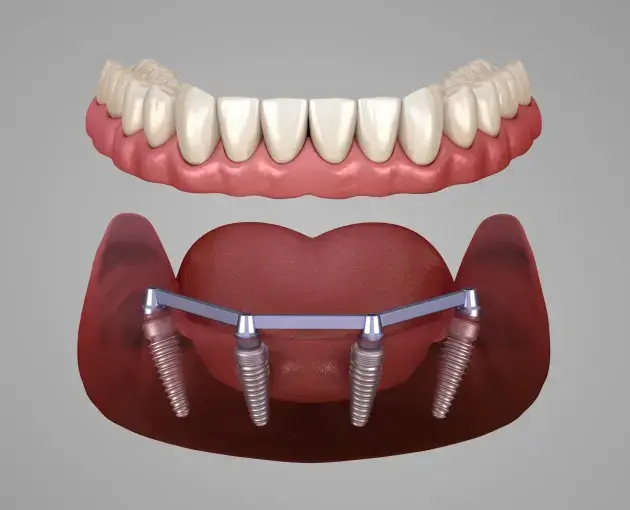
What Is a Full-Arch Fixed Dental Prosthesis?
A full-arch fixed prosthesis is a complete set of upper or lower teeth supported entirely by dental implants. The prosthesis is secured to the implants with precision screws or a milled framework, so only your dentist can remove it.
This differs sharply from a conventional denture in three ways:
- It does not rest on your gums. Chewing pressure transfers into the jawbone through the implants, the way natural tooth roots transmit force.
- It does not need adhesive. There is no paste, no soaking cup and no risk of slipping during a meal or a conversation.
- It helps preserve bone. When teeth are lost, the jawbone that supported them begins to resorb. Implants stimulate that bone and slow the collapse that gives long-term denture wearers a sunken facial profile.
All-on-4 and Other Full-Arch Configurations
All-on-4 is a specific and widely used approach in which four implants support an entire arch. The two rear implants are placed at an angle, which allows them to engage denser bone toward the front of the jaw and often avoids the need for bone grafting or sinus lifting.
All-on-4 is a starting point, not the only option. Depending on your bone volume, bite force and arch shape, our prosthodontists may recommend:
- All-on-4: Four implants per arch. Efficient, well documented and often possible in patients with moderate bone loss.
- All-on-5 or All-on-6: Additional implants for greater load distribution. Frequently recommended for the upper arch, for patients who grind, and for patients with a strong bite.
- Implant supported bar overdenture: A milled bar splints the implants together. Useful in specific anatomical situations and when future serviceability is a priority.
The number of implants is a clinical decision driven by your anatomy, not a package you select from a menu.
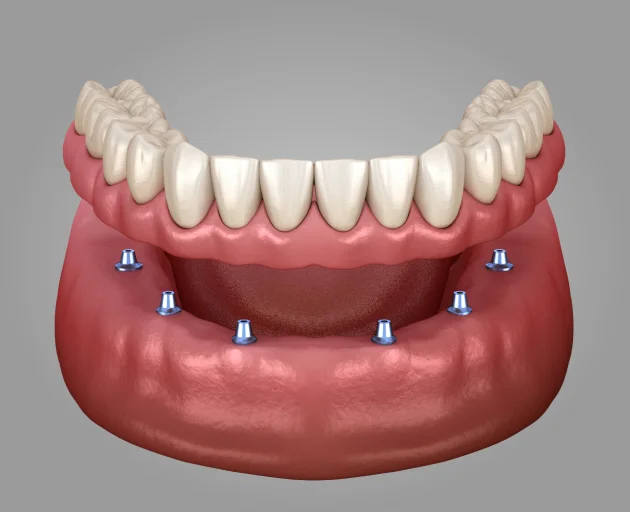
What Is an Implant Overdenture?
An implant overdenture is a full arch of teeth that is supported by dental implants but remains removable by you. It sits on the implants rather than resting entirely on your gum tissue, which gives it far greater stability than a conventional denture, and you take it out to clean it and to sleep.
For many patients the overdenture is the right answer rather than a compromise. It is often achievable with fewer implants than a fixed prosthesis, it is easier to clean thoroughly because you can hold it in your hand, and it can provide lip and cheek support in cases where significant bone has already been lost. It is also one of the most serviceable designs in implant dentistry, which matters over a twenty year horizon.
There are two primary designs, and the difference between them is how the prosthesis connects to your implants.
Milled bar overdenture. A custom bar is milled from titanium or a similar alloy and screwed across the implants, splinting them together into a single connected unit. The overdenture then clips onto that bar. Because the bar distributes chewing force evenly across every implant rather than loading each one independently, this design is the more robust of the two. It is frequently recommended when bone quality varies across the arch, when implants are not ideally parallel, when the arch needs maximum stability, or when you want the highest level of retention available in a removable prosthesis. The bar is custom fabricated for your mouth, so it also allows precise control over the position and angle of the attachments.
Locator or stud attachment overdenture. Each implant receives its own individual attachment, commonly a Locator style or ball style stud, that projects above the gum line. Matching housings inside the overdenture snap onto them, so the prosthesis clicks into place when you seat it. There is no connecting bar. This design is less complex, requires less vertical space inside the prosthesis, is simpler for patients to clean around, and the retention inserts are quick and straightforward to replace when they wear. It is a common choice for the lower arch, where two to four implants can transform the stability of a denture that previously would not stay down.
Both designs rely on replaceable retention components, which wear with use and are changed periodically as routine maintenance. Which one suits you depends on your bone, your bite, the number of implants available, how much vertical space exists between your jaws, and how you manage cleaning at home.
How to Decide Which Prosthesis Is Best for You
With a fixed full-arch prosthesis, a milled bar overdenture, and a locator attachment overdenture all on the table, the natural question is which one is right for your mouth. That answer comes out of your consultation, not out of a brochure.
Our doctor will begin by asking what you actually want from your teeth. How you want to be able to eat, how you want your smile to look, what bothered you about any prosthesis you have worn before, and what day-to-day experience you are hoping for. Those goals shape everything that follows.
From there, our team will perform a thorough examination of your mouth and review your X-rays and 3D imaging. That exam assesses your remaining teeth, the condition and contour of your gum tissue, your bone volume and density across the arch, the position of nerves and sinuses, and how your upper and lower jaws relate to one another.
The recommendation is then built from your goals and those clinical findings together, weighed against several factors that are specific to you:
- Your unique anatomy. Bone volume and quality, arch shape, the amount of vertical space available between the jaws, and the position of anatomical structures all determine which designs are even possible.
- Your lifestyle. What you eat, how you speak and present at work, whether you travel frequently, and how much chair time you can realistically commit to.
- Your oral hygiene habits. Different prostheses demand different cleaning routines, and manual dexterity and daily consistency are legitimate clinical factors. The best design is one you can actually keep clean.
- Serviceability needs. How easily the prosthesis can be adjusted, repaired, relined, or modified years from now. Some designs are far simpler to service than others, and that matters over a long horizon.
- Your bite. Chewing force, clenching and grinding habits, and how your teeth come together all affect how much load the prosthesis and implants will carry, and therefore what materials and implant numbers are appropriate.
We will walk you through the tradeoffs of each before treatment begins, so the choice is informed rather than assumed.
We often work with other specialists to provide a team approach for maximizing outcomes and results. Coordinating care across the surgical and restorative sides of a case means your treatment is planned as one unified sequence rather than a series of disconnected steps.
Living With a Full-Arch Fixed Prosthesis
Your prosthesis is cleaned in place. Most patients use a soft brush, a water flosser and a threading floss or specialty brush to clean beneath the prosthesis where it meets the gum tissue. That undersurface is the single most important area to keep clean, because tissue health around the implants is what protects the long-term result.
We recommend professional maintenance visits two to three times per year. Periodically we remove the prosthesis entirely, clean it in the lab, inspect the implants and retorque the screws. Patients who keep these appointments consistently get dramatically better long-term outcomes.
Schedule Your Full-Arch Consultation in Reno
If you are wearing a denture you cannot tolerate, facing the loss of your remaining teeth, or researching All-on-4 for the first time, the right next step is an evaluation with a prosthodontist who does this work regularly.
Call our Reno office at 775-323-3574 to schedule your consultation. We serve patients throughout Reno, Sparks, Carson City and the greater northern Nevada region from our office at 1601 Lakeside Dr.
New Patients Appointment Welcome!